
AI Maintenance Data Solutions
Maintenance is central to sustaining operational excellence in heavy industry. Our solutions harness AI and advanced technologies to streamline the entire maintenance lifecycle, from defining asset needs and planning strategies to executing work, monitoring conditions, taking corrective actions, and capturing outcomes. We deliver deeper insights, drive continuous improvement, and help ensure more reliable operations.
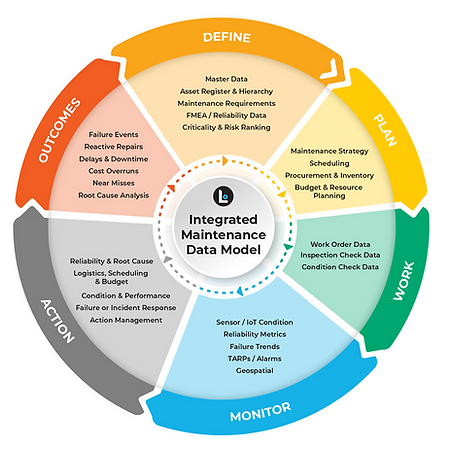
INTEGRATED MAINTENANCE DATA MODEL
All Libero AI maintenance data solutions employ our Integrated Maintenance Data Model (IMDM) to revolutionise how you gather and leverage maintenance data, leading to improved equipment reliability and performance.
This approach provides a broader and deeper perspective of the effectiveness of your maintenance effort, allowing you to swiftly detect emerging maintenance issues and mitigate potential risks to operational performance.
IMDM Process:
-
Define: Define maintenance scope, document objectives and constraints, and identify critical failure modes
-
Plan: Develop maintenance strategies, schedule tasks and resources, and ensure necessary parts and labor availability.
-
Work: Execute all maintenance tasks and capture all relevant data (parts, labor, completion notes).
-
Monitor: Monitor asset health, detect trends early, and prevent unplanned downtime.
-
Action: Implement and track triggered actions, ensuring closed-loop follow-up on improvements and corrective measures.
-
Outcomes: Capture unplanned failures, cost overruns, and production delays, generating insights for iterative improvements.

THE AI MAINTENANCE DATA JOURNEY

PHASE 1
IMPROVING YOUR MAINTENANCE DATA
Improving data quality is the essential first step to improved maintenance outcomes.
Higher-quality data on equipment performance (e.g. sensor data accuracy) means AI-driven tools can better anticipate mechanical failures and schedule proactive repairs, minimising downtime and enhancing operational continuity.
The phase utilises the following AI / analysis methods:
-
Agents
-
Sensor Fusion
REAL-WORLD APPLICATION EXAMPLES:
-
Automatically generate or update maintenance work orders when a certain risk threshold is crossed - minimising reliance on manual monitoring.
-
Combine multiple sensor streams (e.g., temperature, vibration, acoustic signals) to identify early warning signs of component degradation.
PHASE 2
HARNESSING YOUR MAINTENANCE DATA
Once your maintenance data quality at capture is improved, we help harness it.
We analyse maintenance data in the context of operations schedules and safety requirements, helping managers allocate resources efficiently and prioritise interventions that prevent bigger issues down the line.
The phase can utilise the following:
-
Machine Learning
-
Event Correlation Analytics
-
Simulation-Based Scheduling
-
Generative AI
REAL-WORLD APPLICATION EXAMPLES:
-
Predictive models for component failures or optimal maintenance intervals.
-
Cross-reference seemingly unrelated anomalies (like small coolant leaks and sporadic vibration spikes) to pinpoint underlying issues before they escalate.
-
Evaluate various “what-if” scenarios (e.g., mid-shift vs. off-peak servicing) to optimise maintenance windows, reducing production interruptions.
-
Draft site-specific service instructions by synthesising best practices from past repairs, operational guidelines, and manufacturer recommendations.


PHASE 3
LEVERAGING YOUR MAINTENANCE DATA
Once your maintenance data is harnessed, our AI solutions help leverage it to provide actionable insights.
AI-driven analyses help refine maintenance schedules over time, showing exactly which machines benefit most from proactive servicing based on real-world wear patterns. This shifts your approach from generic time-based checkups to more precise, condition-based interventions.
The phase can utilise the following:
-
Machine Learning
-
Agents
-
Neural Time-Series Forecasting
REAL-WORLD APPLICATION EXAMPLES:
-
Continuously refines maintenance schedules based on in-field sensor data and past maintenance outcomes.
-
Automatically schedule or suggest interventions as thresholds are reached.
-
Predict remaining useful life (RUL) of critical components under varied operational loads, ensuring service occurs right before failure risks rise sharply.
OUR MAINTENANCE SOLUTIONS

MAINTENANCE DATA INSIGHTS
Turning disparate data into maintenance improvements
Libero AI's Maintenance Data Insights provide a fast, impactful way to:
-
Leverage your existing data
-
Identify emerging areas of equipment failure
-
Understand the effectiveness of standard maintenance actions
-
Build momentum for larger AI initiatives
Using Natural Language Processing (NLP) on, for example, work order completion comments, we can uncover hidden relationships and emerging trends, enabling data-driven decisions at every organisational level.

RISK REGISTER QUALITY ASSESSMENT
Uncover the real risk your business faces
Libero AI's Risk Register Quality Assessment is an AI-driven assessment of your risk register that can precisely align managed risks with those experienced in the field by using robust data capture and the Causal Network Topology Analysis (CaNeTA), developed at The University of Queensland.
Our proven methodology, rooted in comprehensive data gathering, transformation, integration and organisation, converts disparate information into actionable insights.

AI PILOT
Transform your AI vision into reality with a Libero AI pilot project
Your organisation has explored AI use cases and is now ready to take the next step: building a pilot.
Libero AI's AI Pilot is here to bring your AI use case to life. Leveraging our expertise and IBM’s watsonx technology, we create tailored AI solutions that align with your business needs, integrate seamlessly with your existing systems, and deliver measurable value.
Through Solution Workshops we define value and the pilot scope. The Build stage develops a solution for your high-impact use case, delivering a functional pilot that meets your requirements and success criteria. Finally, we work with you to transition your successful pilot into production.


